·3 min read
In a Digital World, Print Still Matters
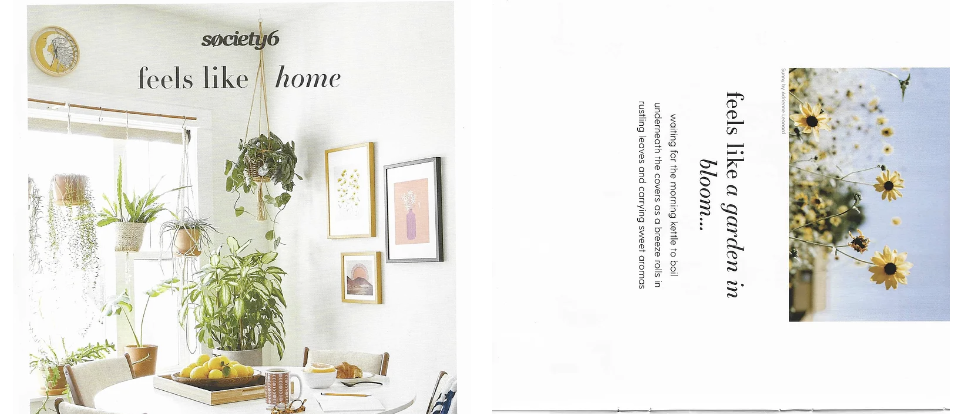
It’s funny how quickly we throw things away.
A postcard from a brand, a seasonal catalog, a little insert tucked into an online order. They land on the kitchen counter, sit in recycling limbo for a few days, and eventually disappear.
What’s easy to forget is how much work goes into making them. Weeks of concepting, photoshoots, editing, layouts, and rounds of approvals. Months of staring at something on a screen, tweaking the smallest details, until one day it becomes a physical object you can actually hold.
There’s something incredibly rewarding about that moment.
At Society6, I project-managed seasonal mailers and catalogs, helping shape the photography direction and overall creative vision and managing the photoshoots that brought each campaign to life. Seeing those projects move from an idea to something printed and in my mailbox a few weeks later was a different kind of satisfaction than seeing a campaign go live digitally.
Maybe part of it is nostalgia. I grew up looking forward to catalogs arriving in the mail, circling things I wanted for Christmas, and getting excited about magazine subscriptions. There was something special about having something to flip through, dog-ear, save, or leave tucked under my bed for weeks.
I think about that feeling when I look at a copy of Nectarine Magazine sitting at the top of my coffee-table book stack. Erik came up with the concept A Stiff Drink in a Dark Bar, and we visited locations and shot the story on 35mm film for a submission to the magazine. We were selected for print that year, and seeing those images on the page felt incredibly special.
It was also a pivotal project for me. It helped define the aesthetics I was drawn to and the kinds of creative work I wanted to pursue. And unlike a post that eventually disappears into a feed, that magazine is still sitting in my living room.
That’s what I find interesting about physical media. It has a kind of permanence that digital content often doesn’t. It takes up space. It invites you to interact with it. And sometimes, it sticks around long enough to become part of your life.
Think about early Glossier: the seasonal stickers, the postcards tucked into orders, the things people saved and pinned to their bulletin boards. Those small details became part of the brand experience. They gave customers something to keep, beyond the product itself.
I think there’s an opportunity for brands to think more intentionally about these kinds of touchpoints, especially when so much of our daily interaction with brands happens through screens. Print doesn’t have to replace digital, and it doesn’t have to be elaborate or expensive to be meaningful. But a well-considered physical object can create a connection that’s harder to replicate with another impression in a feed.
And this extends beyond marketing for me.
I’ve recently found myself enjoying carrying business cards again. It reminds me of my parents, who always had theirs with them when I was growing up. I used to keep one of my mom’s business cards in my backpack at school and look at it whenever I missed her.
It was just a business card. But to me, it was something I could hold onto that made me feel a little closer to her.
That’s the thing about physical objects. You never really know what someone will attach meaning to, or what they’ll choose to keep.
As a creative, having something tangible to show for the work you’ve done feels meaningful in a way that’s hard to explain. It’s proof that an idea made it out of your head, through countless iterations, and into the world.
And in a landscape where so much content is competing for our attention, maybe that’s worth a little more thought.
xx, MRA